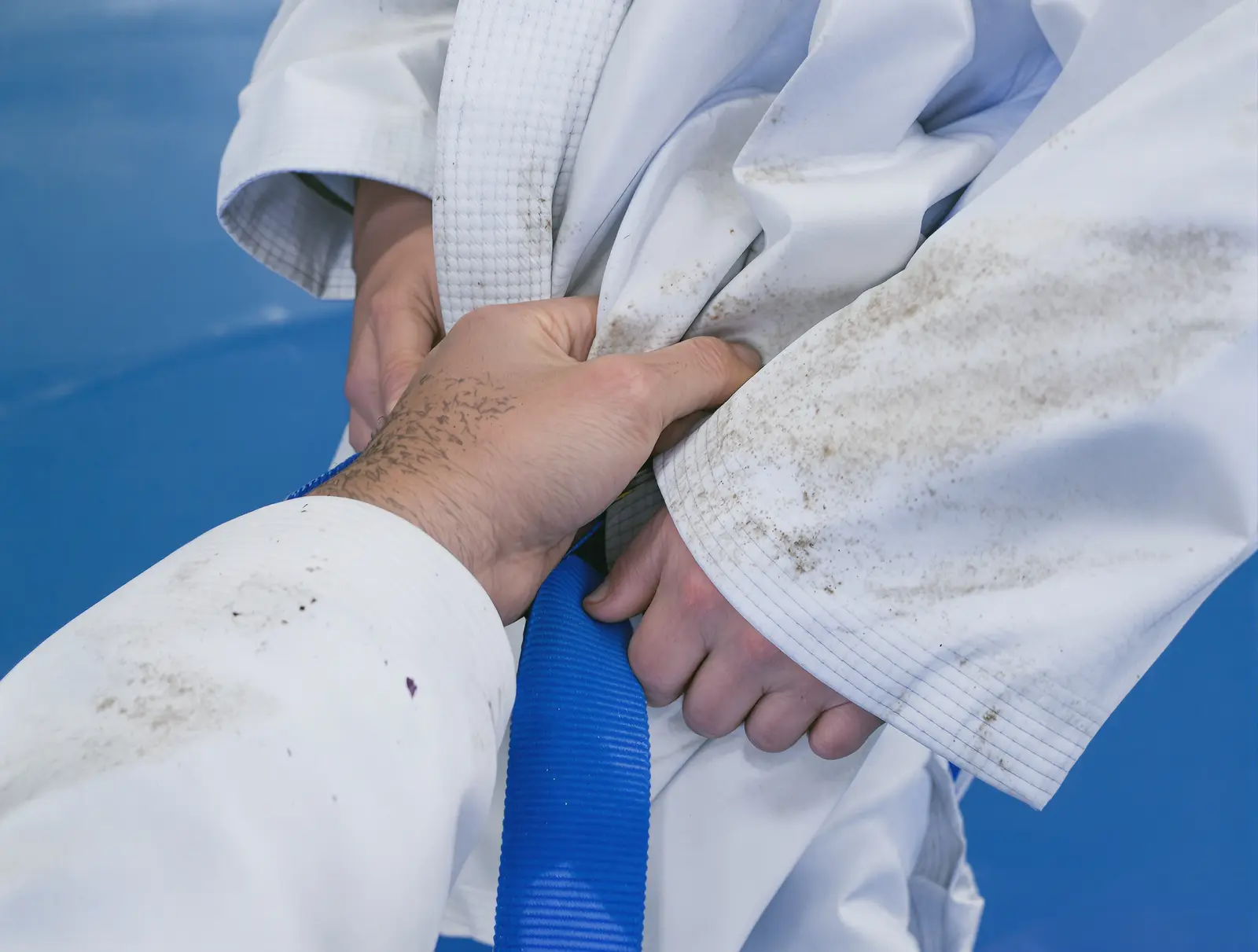
Adult belts (16 and up)
- White: where everyone starts.
- Blue: you know the basics and can defend yourself. Often 1 to 2 years for people training steadily.
- Purple: you start building your own game.
- Brown: refining and tightening everything.
- Black: commonly 8 to 12 years from white belt. Black belts then earn degrees over many more years.
Beyond black there are red-and-black and red-and-white belts, given for decades of teaching. You'll rarely see them.
Kids belts (under 16)
Kids start at white, then move through grey, yellow, orange and green, often with white or black bars in between. At 16 they move into the adult belts.
What the stripes mean
Most schools add up to four stripes (pieces of tape) to the black bar at the end of the belt between promotions. They mark progress, so you're not waiting years with nothing to show for it.
How you get promoted
Your instructor decides, based on how much you train, your technique, and how you roll. There's no shortcut: showing up consistently is what moves you forward. On the Redlands schedule, Advanced classes are for adults with a white belt and three stripes or higher.
Every black belt was a white belt once
Your first class is free. Sign up and you'll get a text with the next two beginner classes.
Questions
What are the BJJ belts in order?
Adults: white, blue, purple, brown, black. Kids under 16: white, grey, yellow, orange, green, then adult belts at 16.
How long does it take to get a black belt in BJJ?
Commonly 8 to 12 years of steady training. It depends on how often you train and your instructor.
What do the stripes on a BJJ belt mean?
Progress between belts. Most schools give up to four stripes before the next belt.
Your first class is free
Fill out the form and we'll text you the next two class times.
Get my free class24656 Redlands Blvd, Redlands, CA 92354